What are knowledge graphs and how can they support under-resourced languages?
We propose a methodology for creating Knowledge Graphs (KGs) for under-resourced languages to bridge the digital divide.

We propose a methodology for creating Knowledge Graphs (KGs) for under-resourced languages to bridge the digital divide.

We introduce various aspects of the knowledge graphs lifecycle namely creation, hosting, curation and deployment. We define each task, give example approaches from the literature …
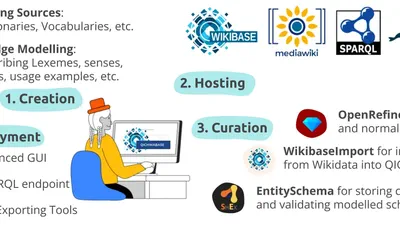
We propose QICHWABASE to support the harmonization process of the Quechua language and knowledge, and its community.
The Qichwabase, is a Knowledge Graph, which is accessible on the Web, retrievable by machines, and curated by Quechua users..
The paper provides an overview of various quality dimensions (QDs) and quality metrics (QMs) that are specific to KGs. Furthermore, we propose a general-purpose, customizable to a …
The paper provides an overview of the typical aspects of the studied search services, including process models, data preparation and presentation, common methodologies and …
We propose a practical knowledge graph curation framework for improving the quality of KGs.
We propose and implement a Validator that computes a confidence score for every triple and instance in KGs. The computed score is based on finding the same instances across …
We survey the methods and tools helping to achieve the development and application of machine-processable (semantic) annotations of content, data, and services, as well as their …
We perform a literature review on DD methods and tools, and an evaluation of them..