MindLab

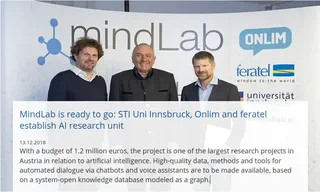 Image credit: Elwin Huaman
MindLab is a cooperative research project with the goal to develop methods and software tools for modeling and implementing scalability for knowledge graphs.
With voice assistants like Amazon Alexa and Google Home, artificial intelligence has found its way into households. People can easily access information over the internet or order products online without having to leave the house or use a computer. You just talk to your digital assistant and it does the work. Automated customer communication is the current topic. However, this poses particular challenges for all those who want their content to be discoverable on these new channels.
In order for this to be possible, language must first be broken down into individual intentions and associated parameters. It is structured and described according to a specific scheme. In order to be able to use data for human language queries and dialogues, it must be made readable by computers. For this purpose, so-called knowledge databases are set up and linked to systems and data from customers, including feratel Deskline or feratel webcams. Language queries and dialogues can only be processed by machines if they are placed in a context of existing knowledge and understood semantically.
